


“The end of the IT department – is it in the cloud?” This was the question asked by the headline of the British magazine Computer Weekly back in 2009. Ten years ago, this new five-letter technology started to appear on the covers of technology and business magazines. Which parts of what was promised came true? And which parts have been a lesson in over-optimism? Together with three IT specialists from Soitron, we dissected the cloud into bits and pieces.
One of the first cloud ads dates back to 1993. It was an ad by AT&T simply entitled “What Is The Cloud?” (the video is still available on YouTube). The three advertised key benefits of this completely unknown technology were choice, control, and convenience.
The king is dead. Long live … many kings
There is no denying the fact that the cloud has made IT services more accessible. All of a sudden, the traditional players had new competition. Who would have said in its early days that one day Amazon would be selling computing power and data storage as well as material goods?
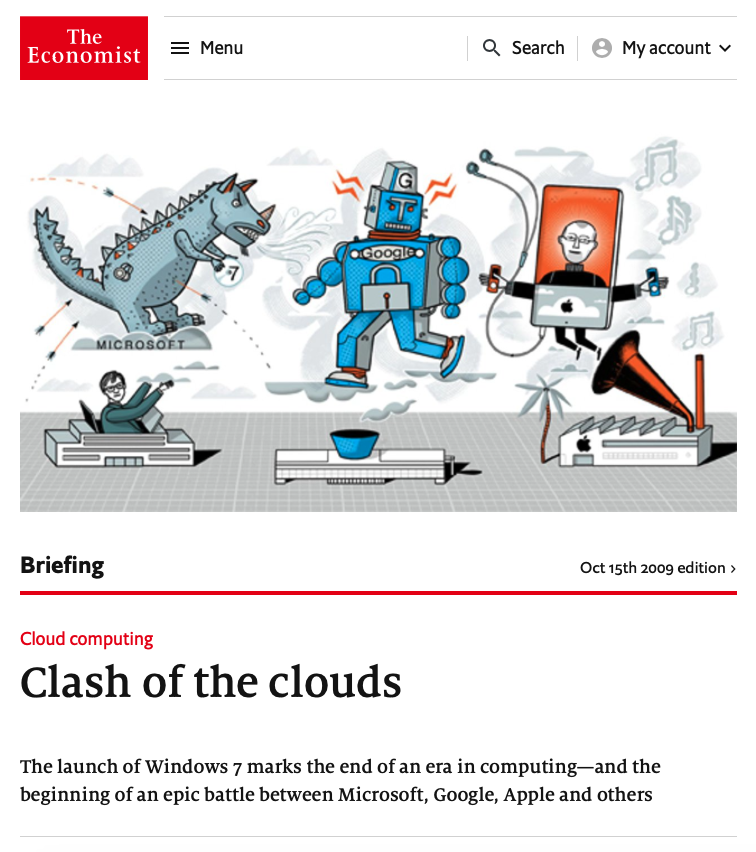
The arrival of the Windows 7 operating system in 2009 was a major milestone for the cloud. Despite the commercial success of this new system, the cloud market has been much more strongly affected by its competitors.
Source: reprofoto, The Economist
The cloud simplified the calculation and comparison of corporate IT costs. “The cloud made it much easier for IT people to provide relevant arguments about the costs. This is much clearer for CFOs – unlike in the past, when IT departments would say that, in addition to CRM systems, they also needed to buy additional data storage, add servers, increase computing power, and so on,” says Zbyszek Lugsch, an IT consultant from Soitron. On the other hand, it led to the misleading impression that the cloud was always less expensive. “Since the advent of the cloud, new technologies have emerged, such as hyperconverged infrastructure: this has brought the price of on-premises solutions down so much that when I compare the cost of the same computing power, servers, storage, and so on in the cloud, and I also include the management costs, I realize that having my own on-premises infrastructure would actually be less expensive.”
IT specialist: The cloud is not for everyone, but every company can enjoy its benefits
Many companies cannot afford to move their sensitive data and critical applications to the cloud, but they would love to use something that is just as easy to manage – where storage or a new server is just a few clicks away, and you can use it immediately.
One solution is a “hyperconverged infrastructure” integrating all three hardware components – storage disks, computing power, and networking – into a single “box” with unified management. This eliminates the need to change or set up hardware every time a new application or an upgrade is deployed.
Our data is safe … somewhere else
The problem is more than just the protection of sensitive data and GDPR compliance. Many companies cannot migrate fully to the cloud, because the downtime or unavailability of their critical applications would cripple their operations.
“Let’s take the example of a local manufacturing plant that produces parts for car manufacturers using a ‘just in sequence’ system [i.e. parts arrive at the assembly line exactly at the moment they are needed]. They have their information system in a data centre in Germany. Can you imagine what would happen if they lost connectivity to Germany? Their production would stop. In their case, this would mean fines that they have no chance of paying. That is why they have a second data centre in the plant as part of their own hyperconverged infrastructure, where they keep a copy of the information system,” explains Lugsch.

The automotive industry is a sector where there is simply no room for downtime.
This is why some companies that have tried the cloud are considering at least a partial return to their own “on-premises” infrastructure. “For instance, large retail chains used to have strictly centralized systems, but today they tend to switch to distributed systems. This means that they have at least part of their infrastructure in their subsidiaries.”
Sit back, relax … and wait
Lugsch’s colleague Marianna Richtáriková is in charge of computer networks. “Our customers, even the really large ones with the latest broadband connections, sometimes experience sudden traffic overloads and application slow-downs, and then we discover, for example, that this was caused by Microsoft updates,” says Richtáriková, correcting the misconception that with high-speed guaranteed internet corporate IT would be as fast as if the company had it on their own premises. “If someone had believed that the connections would become so inexpensive that it would not be a concern anymore, and that the capacity would increase, this turned out not to be entirely true.”
The bottleneck is not just the line speed and throughput but also the availability of services and, more importantly, data. Many data centres guarantee 99 per cent (or even higher) availability. But it is important to know what it actually means.
The availability of services and the availability of data are two different things. “Services include things like email. It will run with 99 per cent availability – i.e. the mail server may be down for only a few hours a year. However, the availability of your corporate data, such as the data you have stored in your SharePoint, is something entirely different. Information about data availability is often hidden somewhere deep in the small print. If you manage to find it, you realize how much it would cost you to ensure the 99 per cent availability of your files. As a result, you need to either create some backup scenarios so that you can restore the data, or you need to buy another service. And suddenly the price is in a totally different ballpark,” says Soitron consultant Štefan Pater in conclusion.